 Matthew Firth · Nov 4, 2026 · 6 min read
The question usually arrives as one line in a security questionnaire: “Do you have SOC 2 or ISO 27001?” Search for the difference and nearly every answer on the first page comes from a company that sells compliance automation or performs the audits. Those pages are mostly accurate. They compare the two as products, though, side by side on cost, effort and reputation, and I think that starts in the wrong place.
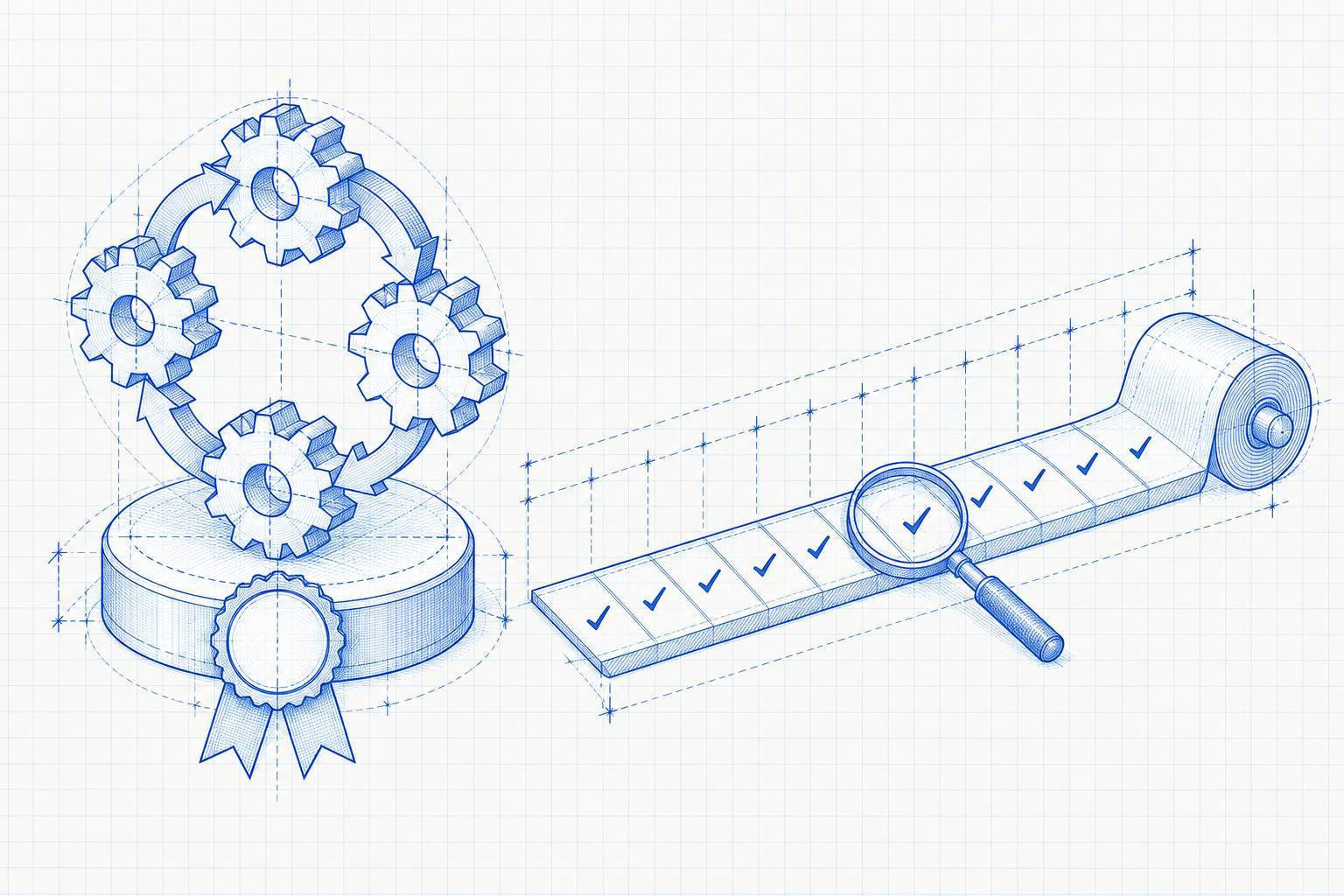
My thesis, offered as my own view rather than audit doctrine: ISO 27001 and SOC 2 answer different questions a buyer is asking. ISO 27001 asks whether you have a management system that finds your security risks, treats them, and keeps doing that year after year. SOC 2 Type II asks whether a specific set of controls actually ran, for a specific system, across a specific stretch of months. So “which one?” is decided by the question in your buyer's questionnaire, not by which framework sounds more serious.
What each one actually certifies
ISO/IEC 27001 is the international standard for an information security management system, or ISMS. ISO's own page is plain about two things people get wrong: certification is “possible but not obligatory,” and ISO does not perform certification. Accredited certification bodies do. The audit runs in two stages, a documentation review and then a conformance audit, and the certificate is valid for three years, with annual surveillance audits in between. What you get is a short certificate with a scope statement. It tells a buyer your system for managing risk exists and was found to conform. It does not say how any one control performed last March.
SOC 2 is not a standard you certify against. It is an attestation report a CPA firm issues under AICPA standards, which the AICPA describes as an “assertion-based examination of a service organization's description of its system” and its controls. The criteria cover security, availability, processing integrity, confidentiality and privacy. A Type I report looks at whether controls are designed properly at a point in time. (I've written separately on how to choose between Type 1 and Type 2.) A Type II report covers a period and addresses operating effectiveness, usually 6, 9 or 12 months, with 12 the most common. What you get is a long document: your system description, the auditor's tests, the results, and any exceptions.
| ISO/IEC 27001 | SOC 2 Type II | |
|---|---|---|
| Question it answers | Do you run a system that finds and fixes your security risks? | Did these controls operate, for this system, over these months? |
| What you hand a buyer | A certificate with a scope statement | A detailed report with tests and exceptions |
| Who issues it | An accredited certification body | A licensed CPA firm |
| What it is measured against | Clauses 4 to 10 of the standard, plus the Annex A controls you choose | The AICPA Trust Services Criteria |
| Time it covers | Conformance at audit, kept current by annual surveillance over three years | A review window, usually 6 to 12 months |
| Can it be posted publicly | Yes, certificates are routinely shared | Normally shared under NDA; a SOC 3 is the public version |
The question in the questionnaire decides it
Here is the rule I would use before spending a dollar on either. Pull the last five security questionnaires or vendor onboarding forms you received. For each one, write down the artifact it names. Not the controls it asks about, the document it asks you to attach.
- Most name a SOC 2 Type II report. Start there. Those buyers want proof that controls ran, and a certificate will not answer them.
- Most name an ISO 27001 certificate. Start there. The commonly repeated pattern is that buyers outside the US ask for ISO by name more often than US buyers do, so look at where those five customers are based.
- Most say “SOC 2, ISO 27001 or equivalent.” Pick the one closest to what you already run. If you already keep a risk register, hold management reviews and run internal audits, you have an ISMS in all but name and ISO is the shorter step. If you have strong automated controls and logs but none of that paperwork, SOC 2 is.
- Most list controls and name no framework. You may not need either yet. Answer the questionnaire honestly and keep the evidence, because you will need it later.
Five is a small sample, and that is the point. It takes an afternoon, and it replaces a debate about reputation with a count of what your customers actually asked for.
For engineers, the difference is evidence
For an engineering organization, the practical gap between the two is the shape of the evidence. An ISO audit asks whether your management system exists and turns over on its cycle: the risk assessment, the Statement of Applicability, the internal audit, the management review. Much of that is process evidence that the security function produces.
A SOC 2 Type II audit samples across the whole window. The auditor can pick a production change from month two, an access review from month seven, a backup restore test from month ten, and ask to see the record for each one on its date. If the record does not exist, that is an exception, and it is printed in a report your customers will read. A control that ran but left no dated trace looks the same as a control that never ran.
That makes SOC 2 Type II an engineering problem more than a policy problem. The question is whether your systems write down that a control ran as a side effect of normal work, so nobody has to reconstruct it later. It is the same discipline I argued for in the piece on git commit trailers: put the record on the change, where one command can find it months later. And it is why I like controls that are enforced in the tool rather than in a document, like keeping the push to main for a person. A gate that only a human can open produces its own record every time it is used.
My view is that teams who find their first Type II painful are mostly discovering that their evidence was never being kept. The audit did not create that problem. It only made it visible.
What is current in 2026
Both frameworks have moved recently, and some of what still circulates is out of date.
The current ISO standard is ISO/IEC 27001:2022, published in October 2022. Its Annex A has 93 controls in four themes, organizational, people, physical and technological, down from 114 in the 2013 edition. Certificates to the 2013 edition had a transition deadline of October 31, 2025 under the IAF's transition rules, after which certification bodies expire or withdraw them. A February 2024 amendment added one requirement: decide whether climate change is a relevant issue for the ISMS.
SOC 2 examinations today use the AICPA's 2017 Trust Services Criteria with revised points of focus from 2022. That is about to change. On October 28, 2026 the AICPA proposed 2027 criteria, with comments open until January 15, 2027. If approved, they would apply to engagements beginning on or after December 31, 2027, and the new points of focus include AI governance and model monitoring. If you are scoping a first SOC 2 now, read the exposure draft before you design controls you will have to rework.
If you end up doing both
Many companies do, usually because their customer list spans both kinds of buyer. Vendors publish estimates of how much the two overlap, and the overlap is real, but treat any single percentage as an estimate from someone selling the mapping. The part that actually transfers is the evidence. If your systems already produce dated records that controls ran, the second audit is mostly a matter of mapping. If they do not, the second audit repeats the first one's pain.
Frequently asked questions
Should I get ISO 27001 or SOC 2 first?
Get the one your buyers name. Read your last five security questionnaires and count which artifact each asks you to attach. If they accept either, choose the one closer to what you already run: ISO 27001 if you already have a working risk and review process, SOC 2 if you have strong automated controls and logs.
Is SOC 2 legally required?
No. SOC 2 is an attestation report that a CPA firm performs under AICPA standards, not a law or regulation. It becomes a requirement when a customer contract or procurement policy names it, which is common for companies that host or process other businesses' data.
Is ISO 27001 outdated?
No. The current edition is ISO/IEC 27001:2022, published in October 2022 and amended in 2024 to add a climate change consideration. Its Annex A has 93 controls in four themes. What is outdated is a 2013 certificate: the transition deadline to the 2022 edition was October 31, 2025.
Is there a SOC 3?
Yes. A SOC 3 report covers the same trust services categories as SOC 2 but with less detail. The AICPA treats it as a general use report that can be freely distributed, which is why it is the version companies can post publicly while sharing the full SOC 2 under NDA.
What does SOC 2 Type II and ISO 27001 certified mean?
It means a company holds both: a CPA firm's report that its controls operated effectively over a review period, and a current certificate from an accredited certification body that its ISMS conforms to ISO/IEC 27001. Check the dates and the scope of each, because the two can cover different systems.
Sources
- ISO, ISO/IEC 27001 Information security management systems
- AICPA, 2017 Trust Services Criteria (with revised points of focus, 2022)
- AICPA, proposed update of the SOC 2 Trust Services Criteria (Oct 28, 2026)
- AICPA, SOC 3
- Journal of Accountancy, AICPA proposes improvements to SOC 2 trust services criteria
- Cloud Security Alliance, How to prepare for ISO/IEC 27001:2022 (IAF MD 26 transition dates)
- SGS, ISO/IEC 27001:2022 transition support
- SGS, Key changes in ISO/IEC 27002:2022
- URM Consulting, ISO and IAF add climate change considerations
- A-LIGN, ISO 27001 audit essentials
- Linford & Co, SOC 2 Type 2 reports guide