 Matthew Firth · Nov 10, 2026 · 7 min read
Search “AI acceptable use policy” in November 2026 and the first page is mostly templates and how-to guides, many of them published by firms that sell security software or services. The templates are reasonable. They list approved tools, banned data, human review and consequences, in roughly that order. What most of them leave out is the question that decides whether the policy works: for each rule, where does it get enforced, and what record does that leave?
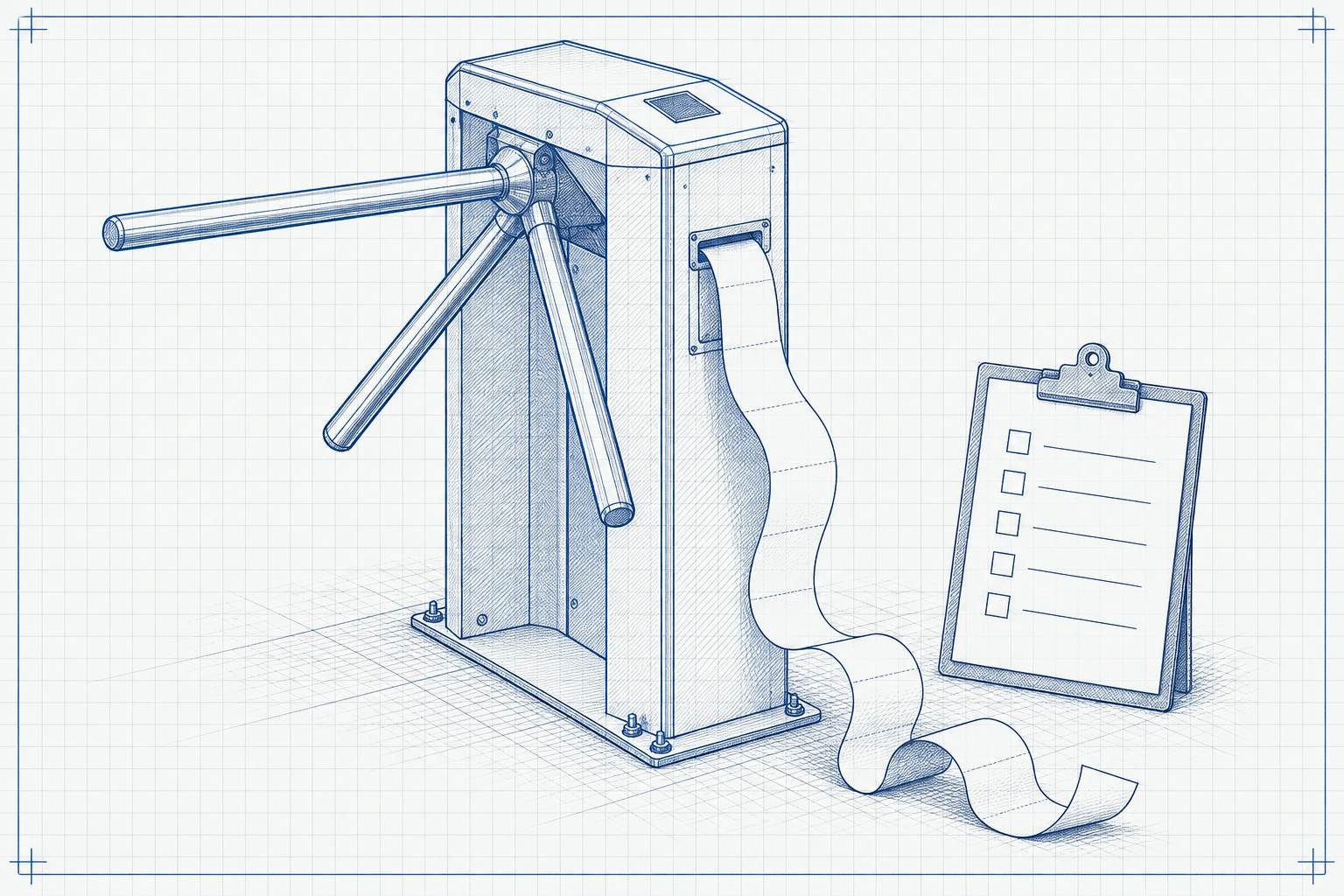
My thesis: an AI acceptable use policy is only as real as its receipts. Every clause needs three parts: a rule people can read, a gate that enforces it somewhere in your systems or process, and a receipt, the dated record that shows the gate ran. A clause with a rule and no gate is guidance. That's fine, as long as the document says so. The failure is a policy full of rules that read as controls and turn out to be wishes the first time an auditor or an incident asks for evidence.
Why the policy keeps losing to the tools
The survey numbers suggest formal policies are still the minority and that use is running ahead of them.
- In ISACA's 2025 AI pulse poll of 3,029 digital trust professionals worldwide (published July 7, 2025), 81 percent said they believe employees at their organization use AI whether it is permitted or not. Only 28 percent said their organization has a formal, comprehensive AI policy, up from 15 percent the year before. Thirty-two percent said no employees get AI training at all.
- The 2024 Work Trend Index from Microsoft and LinkedIn, a survey of 31,000 people in 31 countries, found 75 percent of knowledge workers use AI at work and 78 percent of AI users bring their own tools. Only 39 percent of users said they had received AI training from their company.
Read those together and the problem is where the use happens: in personal accounts and browser tabs, outside any system where a rule could be checked. A policy that only lives in a PDF can't see that use. A policy whose clauses each point at a gate can at least tell you which use it covers and which it doesn't. I made the same argument about AI-written code in the shadow AI risk nobody is auditing: the rule usually exists, and the record usually doesn't.
Rule, gate, receipt
The test for each clause is three questions.
- Rule: can someone who has never seen the policy understand what they may and may not do, in one sentence?
- Gate: where does the organization stop, route or check the action? A login, a network control, a code review, a sign-off, an access grant.
- Receipt: what dated record does that gate produce, and who could pull it in ten minutes if asked?
If a clause has all three, it's a control. If it has a rule but no gate, move it to a section headed guidance and write it as advice. If it has a gate but no receipt, it may be working, but you can't show that it is, which in an audit amounts to the same thing as not working.
The clause worksheet
Here are the clauses most templates include, with an example gate and receipt for each. The gates are examples, not a product list. Use whatever your stack already has.
| Rule | Example gate | Example receipt |
|---|---|---|
| Use only approved AI tools for work. | Approved tools sit behind company single sign-on; a web filter or browser policy blocks known unapproved AI domains. | A tool register with owner and review date; SSO sign-in logs; block logs. |
| Don't put confidential, customer or personal data into tools that aren't approved for it. | Data loss prevention rules on paste and upload to AI domains; an enterprise tier whose contract excludes training on your data. | DLP event logs; the signed terms on file with the tool record. |
| A person reviews AI output before it's used. | For code, a required review on protected branches. For customer-facing text, a named approver step. | Merge request approvals; the approval field on the document or ticket. |
| AI-assisted code is identifiable. | A commit trailer convention checked in CI. | The trailers themselves, queryable with one git command. I wrote this up in the commit trailer piece. |
| AI agents can't ship to production on their own. | Branch protection plus a refusal in the agent's own tooling. | Protection settings history; the push audit log. Details in let the agent commit, keep the push for a person. |
| Staff are trained before they get access. | Access to approved AI tools is granted only after training is complete. | Completion records with dates, matched against access grants. |
| New AI uses that affect people get reviewed first. | A short intake form and risk review before a use goes live. | The register entry: use, owner, decision, date. |
| Report misuse or mistakes. | A named channel or ticket queue. | Tickets with timestamps and outcomes. |
Two rows deserve a note. The training row is where regulation already reaches some companies. Article 4 of the EU AI Act, which has applied since February 2, 2025, places an AI literacy obligation on providers and deployers of AI systems for the staff who operate or use them. I'm not a lawyer, and whether it applies to you depends on where you operate. But if it does, “we told people in the handbook” is a rule. Dated completion records tied to access are a receipt.
The review row is where frameworks point. The NIST AI Risk Management Framework (version 1.0, January 26, 2023) is voluntary and organizes its guidance into four functions, Govern, Map, Measure and Manage. NIST added a Generative AI Profile, NIST AI 600-1, on July 26, 2024. A register of AI uses with an owner and a decision date is a cheap way to give the Govern function something to point at.
Write it short, and split it in two
Templates tend to run long because they try to anticipate every misuse. My preference is the opposite. Put the controls, the clauses with a gate and a receipt, in a short first section that fits on one page. Put everything else in a second section called guidance: be careful with hallucinated citations, don't paste in anything you wouldn't email to the vendor, label AI-generated images. Guidance still matters, as long as it's labeled as guidance.
The split has a practical benefit. When a new tool or a new risk shows up, you can see straight away which section it belongs in. If you want it to be a control, the conversation becomes “what's the gate?” instead of another paragraph of policy language.
How to run it
- Start from use, not from the template. List the AI tools people actually use, including personal accounts, by asking them. The Work Trend Index figure on bring-your-own AI suggests the list will be longer than your approved one.
- Fill in the worksheet for each clause you keep. Any clause without a gate either gets one or moves to guidance.
- Name an owner for each receipt. The owner is the person who could produce the record on request, not the person who wrote the policy.
- Review the tool register on a fixed date. Quarterly is a reasonable starting point. The review itself leaves a receipt.
- Pull three receipts at random before anyone asks. If you can't find one, you've learned which gate isn't working while it's still cheap to fix.
Frequently asked questions
What is an AI acceptable use policy?
It's a document that sets out how people in an organization may and may not use AI tools: which tools are approved, what data can go into them, when a person has to review the output, and what happens when the rules are broken. The useful ones also say where each rule is enforced and what record shows it was followed.
What should an AI acceptable use policy include?
At minimum: approved tools, data that must not be entered, human review of output, training, a review step for new uses, and a way to report problems. For each clause, name the gate that enforces it and the receipt that proves it ran. Anything without a gate belongs in a separate guidance section.
How many organizations have an AI policy?
In ISACA's 2025 AI pulse poll of 3,029 digital trust professionals, 28 percent said their organization has a formal, comprehensive AI policy, up from 15 percent the year before. In the same poll, 81 percent said they believe employees use AI whether it is permitted or not.
Is an AI acceptable use policy legally required?
It depends on where you operate, and I'm not a lawyer. One concrete example: Article 4 of the EU AI Act, applicable since February 2, 2025, places an AI literacy obligation on providers and deployers of AI systems for their staff. Dated training records tied to tool access are one way to show you acted on it.
How often should an AI acceptable use policy be reviewed?
Review the tool register more often than the policy text. Quarterly is a reasonable start for the register, because new tools arrive faster than policy cycles. Review the policy itself at least yearly, or when a new kind of use appears.
Sources
- ISACA, ISACA research: AI use booms while training lags (July 7, 2025)
- Microsoft, Microsoft and LinkedIn release the 2024 Work Trend Index on the state of AI at work (May 8, 2024)
- Regulation (EU) 2024/1689, the EU AI Act (EUR-Lex, official text)
- EU AI Act, Article 4: AI literacy (unofficial reader by the Future of Life Institute)
- NIST, AI Risk Management Framework (AI RMF 1.0, January 26, 2023; Generative AI Profile, NIST AI 600-1, July 26, 2024)